AI & Software
The Request Economy: Why Cloudflare's Monetization Gateway Changes Everything
Agents don't look at ads or hold subscriptions. Cloudflare's Monetization Gateway finally builds the machinery to charge for what machines actually consume, and it changes how every software business should price.
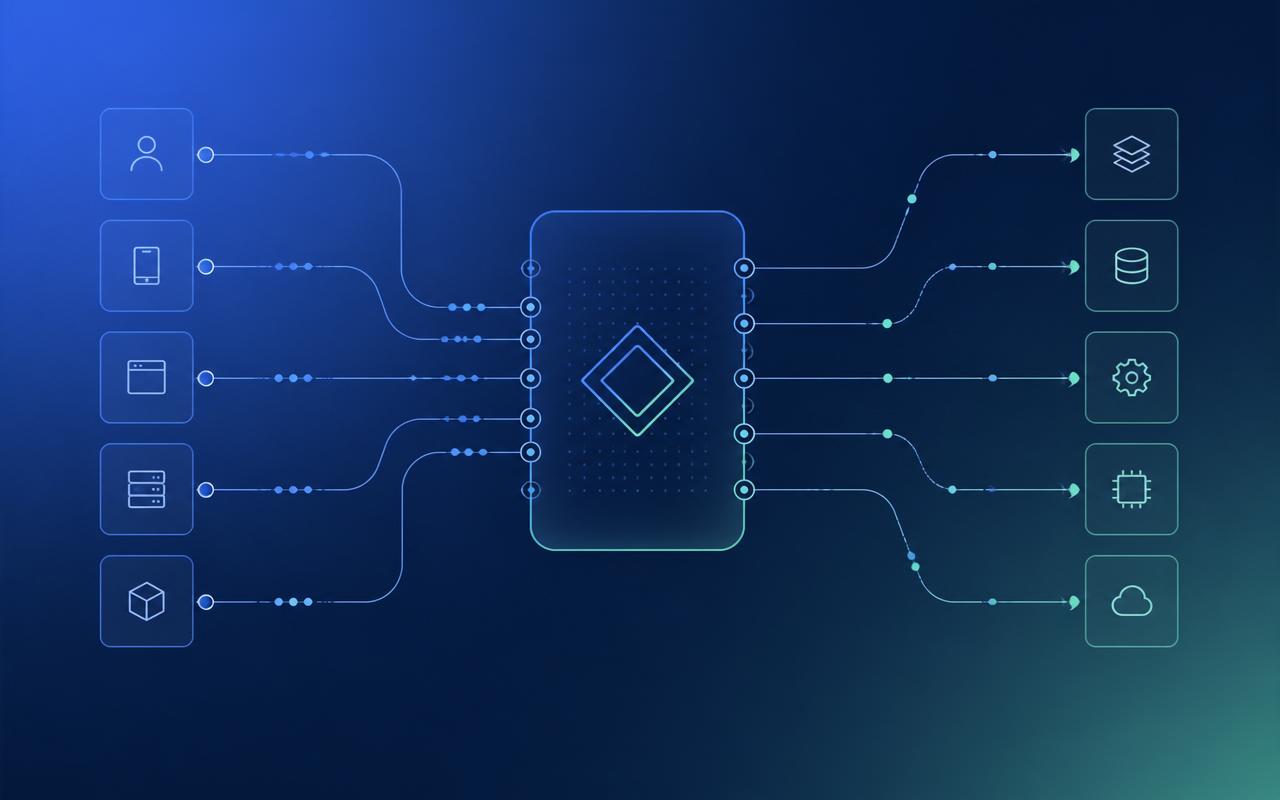
The web was built on a simple deal. Attention has value. Someone looks at a page. Someone clicks. Someone pays. That bargain funded the internet for 30 years because both sides were human.
Agents broke it.
An agent does not look at ads. It does not maintain subscriptions. It reads a page, takes what it needs, and moves on. Cloudflare's own data shows AI crawlers requesting content anywhere from a hundred to tens of thousands of times for every visitor they send back. The attention economy has no mechanism to capture that. Not because the value is small. Because the machinery to charge for it was never built.
That machinery now exists.
Where most AI companies are stuck
Think of pricing as a spectrum. At the top sit models that capture pure value: revenue share, outcome-based, task and action-based. At the bottom sit models priced on cost: seat-based and token billing. The higher you sit, the more your price reflects what the customer actually gets.
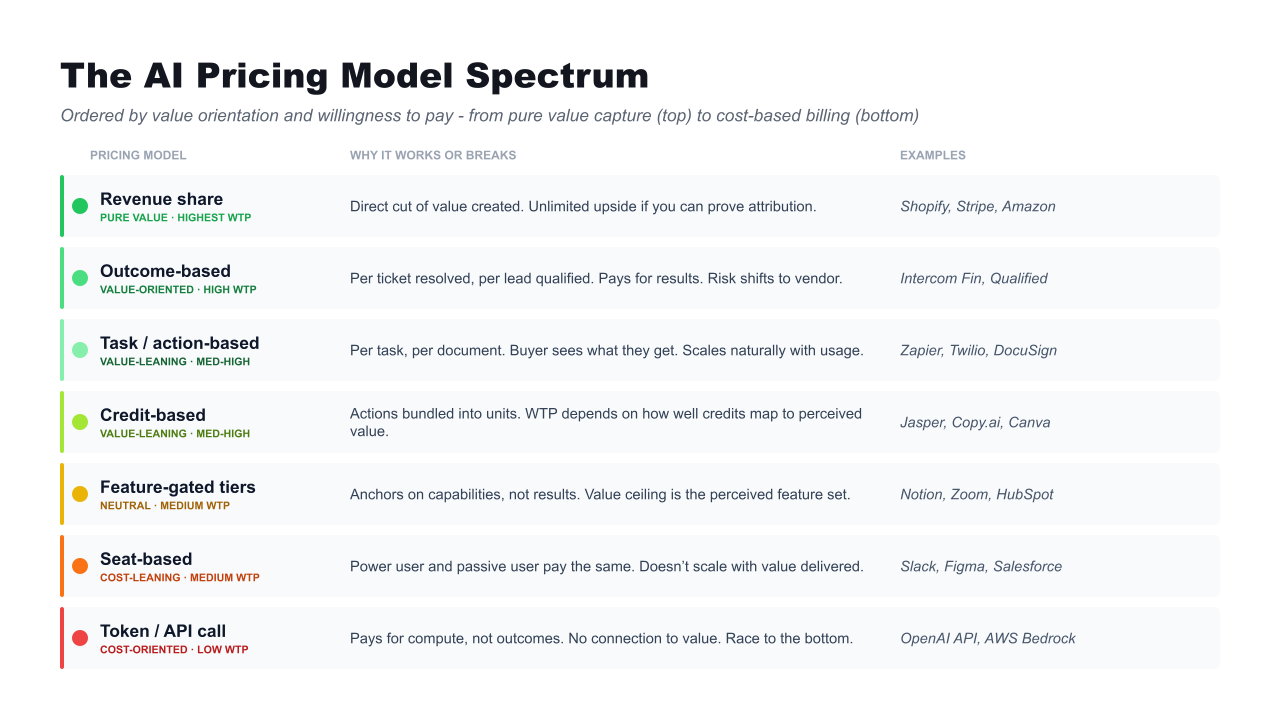
Most AI companies are stuck at the bottom. Seat-based pricing. Per-token billing. Cost-oriented models that made sense when a human was doing the work but lose coherence the moment an agent takes over.
The reason is not that their products lack value. It is that the infrastructure to charge for value at machine speed, at micropayment price points, between parties with no prior relationship, has not existed.
Agents sit at the top of the value spectrum. They resolve tickets, qualify leads, generate revenue. The pricing sits at the bottom. The value captured and the value created have never been further apart.
Every pricing model hits the same wall
Seat-based pricing assumes work scales with people. Agents sever that link. One person can now trigger thousands of compute events in an afternoon. The seat measures nothing.
Token and API call pricing is worse. It pays for compute, not outcomes. No connection to value delivered. The model most AI infrastructure companies started with, and the one most likely to collapse into a race to the bottom as compute gets cheaper.
Move up the spectrum toward outcome-based and task-based pricing and the picture improves. Per ticket resolved. Per document processed. The buyer sees what they get, and the price scales with consumption in a way that feels fair. But these models require something the bottom of the spectrum does not: infrastructure to meter, settle, and verify the result at the machine level.
That infrastructure, until now, has not existed.
What the Monetization Gateway actually does
On July 1, 2026, Cloudflare announced the Monetization Gateway. It lets any Cloudflare customer charge for any asset behind their network: a web page, a dataset, an API endpoint, an MCP tool call. Payment is enforced at the edge before the request reaches your server. Settlement happens in stablecoins via x402, an open HTTP-native protocol.
The pricing examples map directly to the upper tiers of the value spectrum.
A few cents per search. Task-based.
A base fee plus per-megabyte upload charge. Usage with a floor.
Ninety-nine cents per resolved support escalation, paid only when the work succeeds. Outcome-based, billed at the infrastructure layer.
That last one is new. Outcome pricing without building the billing machinery yourself.
Why this changes the terms of the conversation
I have spent years watching SaaS teams try to price products when the buyer is software. The pattern never changes. Agents do not want your UI. They want clean APIs and logic they can call directly. They do not get persuaded. They parse. What they cannot parse, they skip.
The reason micropayments never worked was not demand. Collecting one cent cost more than one cent. Stablecoins dissolve that: settlement in under a second, fees at a fraction of a cent, no chargebacks. The smallest unit of value on the internet can now carry a price.
Stripe confirmed the direction at Sessions 2026: pay-as-token-burns, with stablecoin wallets distributed directly to agents. Not to users. To the agents.
The agent is now the buyer. The request is the transaction.
The model that works
The pricing structure that holds for agent-facing products maps to the spectrum. Three layers, in order, climbing from cost toward value.
Flat base. Gives buyers a number they can budget. Creates the trust needed to start. Day one.
Usage layer. Scales per call, per workflow, per completed task. This is the task-based tier of the spectrum, and where the Monetization Gateway does most of its work.
Outcome layer. Tied to a result both sides can count. Captures upside once measurement and trust exist. Comes last, because it depends on both.
The sequencing matters more than the numbers. You do not start at the top of the spectrum. You build toward it as trust matures. What the Gateway does is make the middle layer trivial. Knowing you should charge per task but not having the billing machinery to do it stops being an excuse.
What this means for your business
SaaS companies face the most exposure and hold the most upside. An agent does not need a seat. It needs an endpoint and a price. The move is to unbundle your API layer and offer an agent-optimized tier priced per call or per task. Capture what you are currently giving away.
API and data companies get immediate relief. They have been subsidizing agent activity with unpaid calls for years. The Gateway ends that. Moving from cost-oriented to task-based pricing is finally operationally feasible. No engineering lift required.
Consulting and services firms have a window. And it is closing.
Clients are already deploying agents instead of buying hours. Competitors are using agents to deliver faster and cheaper. The scarcity that built your revenue model is not coming back.
The firms that move first do not try to protect the old model. They price agent-assisted services per outcome, serve clients they could never previously afford, and undercut the all-human alternative on both speed and cost.
The threat and the opportunity are the same thing. Which side you land on depends entirely on when you move.
Enterprise B2B vendors need hybrid pricing on the roadmap now. Per-seat works for the human layer. But when a customer deploys one agent to do what five people did, you need a clean price per agent event already in place. Wait and you are stuck renegotiating a contract you should have priced correctly the first time.
The unmonetized web is enormous
Cloudflare put it plainly: there is an enormous amount of value moving across the internet today that goes unmonetized, not because no one would pay for it, but because the tools to charge for it have never existed.
Every API call, every answer, every tool invocation an agent makes has value. Almost none of it is paid for today. The entire pricing spectrum exists in theory. Most of it has been inaccessible in practice because the settlement layer for machine-to-machine transactions did not exist.
Now it does.
The builders who move first on agent-readable pricing will not win because they have a better strategy. They will win because they are the only ones priced for what agents actually consume, which means they are the only ones visible to the buyers that matter.
The web's business model just shifted. The question is who notices in time.
See how we apply empirical pricing research in practice: Explore the C.O.R.E. roadmap & 78-artifact catalog